Meme coin trading on a $10 budget works best with strict position sizing and fast exits on Solana
You can order the same kind of articles for your own video to boost it on YouTube and Google. Just message the Telegram bot @sat_sit_bot. It writes articles around your video, embeds the video and publishes them on popular niche websites (no ads). Try it free: 50 articles on us.
· based on the channel gravy
Meme coin trading with a $10 bankroll is possible, but only if you treat fees, position size and exit speed as the strategy rather than the details. A $10 account on Solana can survive five separate trades of 0.05 SOL or less each, provided every buy has a narrative reason and a pre-planned sell. The channel gravy tested exactly this in a five-trade experiment, routing orders through Axiom's referral signup, which advertises doubled cashback and lower fees.
What a $10 meme coin experiment actually looks like
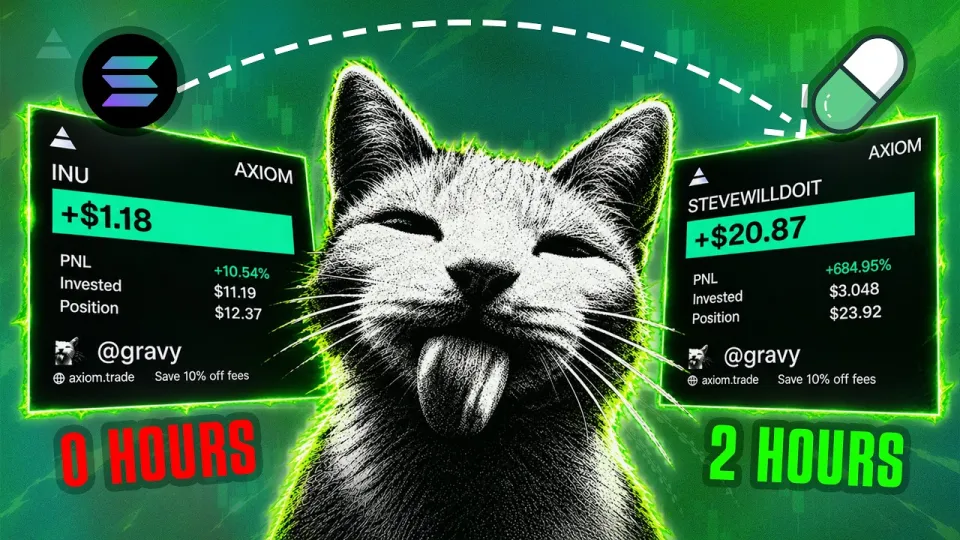
A small-portfolio meme coin run is a sequence of tiny, deliberate bets rather than one big swing. In the gravy video, five trades were placed and none of the buys exceeded 0.05 SOL, which keeps a single loss from wiping the account. The coins were STEVEWILLDOIT, NPC, MET (Meteora), PUMPY the Trader and UNTXD.
Each trade had a stated reason to buy and a stated reason to sell, and one of them was admitted as a clear fumble. That structure matters more than the picks: with $10, you are not trying to compound into thousands in a week, you are trying to stay in the game long enough to learn how Solana meme coin liquidity behaves.
Why fees and slippage decide small-account outcomes
Transaction costs are proportionally brutal on a $10 balance, which is the single most common objection to low-balance meme coin trading. On Solana, a swap involves network fees, priority fees and a platform fee, and on top of that comes price impact from thin liquidity.
- Network and priority fees are fixed per transaction, so they eat a larger share of a 0.05 SOL buy than of a 5 SOL buy.
- Platform fees on aggregators and trading terminals usually run in the fractions of a percent, but they stack with every round trip.
- Slippage on a new pump.fun-style token can be several percent in each direction, so a coin needs to move double digits just to break even.
- Selling into a thin book can cost more than buying, because exit liquidity is often worse than entry liquidity.
A practical rule: the smaller the account, the fewer the trades and the larger the required move before you take profit. Referral cashback, like the program promoted through Axiom, softens this but does not remove it.
The narratives behind the five trades
Meme coin selection on Solana is narrative selection, and the experiment leaned on recognizable stories rather than charts. STEVEWILLDOIT plays on the "Steve will do it" internet persona, a name with built-in recall for anyone who has spent time in degen crypto circles. NPC leans on the non-player-character meme, a label the market uses for people who follow trends without thinking. MET ties to Meteora, the Solana liquidity protocol, which gives the ticker a recognizable brand association. PUMPY the Trader and UNTXD are pure degen fare — mascot energy and a ticker built for a joke.
The X Money coin meta that ran alongside these trades is a useful case study. It moved on e/acc and Cream associations rather than on any product news, which is typical: a token attached to a well-known figure or subculture can re-rate in hours on nothing but attention. The lesson for a $10 trader is that narrative timing beats narrative quality — arriving late to a good story is the same as arriving to a bad one.
A repeatable checklist for $10 meme coin trades
A small meme coin trading strategy is mostly a set of constraints you refuse to break. The following sequence keeps risk bounded while still allowing real exposure.
- Cap each buy at 0.05 SOL or less so no single trade can end the session.
- Write the thesis in one sentence before buying — the specific narrative or catalyst you expect to drive attention.
- Check liquidity and holder distribution first; a token with a handful of wallets holding most of the supply is a rug waiting to happen.
- Set the exit before entry: a target where you take profit and a level where you accept the loss.
- Take partial profit on the first strong spike instead of waiting for a second leg that may never come.
- Log every trade with entry, exit and reason, because with amounts this small the journal is the only real asset you are building.
Common questions from small-portfolio traders
Small accounts run into the same three problems repeatedly, and each has a workable answer. The first is overwhelm: tracking every tweet, remembering who holds influence in a community and scanning dozens of launches is a full-time job, and most people cannot sustain it. Narrow the watchlist to a handful of accounts and one or two ecosystems per session.
The second is timing. Buying a dip and watching everyone else sell, then exiting at a 20–40% loss only to see the coin run later, is the classic small-trader pattern. It usually comes from entering without a thesis and therefore having no reason to hold through a drawdown. The third is record-keeping: viewers of the experiment asked for the final portfolio value, which the video did not state. That is a reminder to compute your own total PnL, including fees, after every session — otherwise you cannot tell skill from luck.
Useful links
- Trade on Axiom with the referral — doubled cashback and reduced fees as advertised in the video.
- The Trenches Discord
- Discord with free Axiom imports and trade signals (NFA)
- gravy on X
- Bitbase leveraged trading with a 20% futures fee reduction
Bottom line
A $10 meme coin account is a training account, and the gravy experiment shows it can be run without blowing up: five trades, every buy under 0.05 SOL, each with a stated reason in and out. The realistic goal is not turning $10 into a fortune but learning how Solana meme coin liquidity, fees and narratives behave with money you can afford to lose entirely. The one fumbled trade is part of the value — it shows that even a prepared plan fails when execution slips. If you want to replicate the setup, start through Axiom and keep the position cap in place.
Key takeaways
- Five real trades, none larger than 0.05 SOL per buy — roughly $10 at Solana prices around $200.
- Coins covered: STEVEWILLDOIT, NPC, MET (Meteora), PUMPY the Trader and UNTXD.
- The X Money meta ran on e/acc and Cream narratives, not on fundamentals.
- The trader fumbled one of the five entries badly, which is the normal cost of learning.
- Fees and slippage on tiny buys decide the outcome as much as the narrative does.
Source: I Tried Trading Memecoins with Just $10 · Markdown version
Questions & answers
Can you really trade meme coins with only $10?
Yes, technically, but the $10 is a learning budget rather than an investment. On Solana you can place several buys of 0.05 SOL or less, which keeps individual losses small. Fees and slippage will consume a meaningful share of any profit, so expect the experience to cost more than it earns at first.
How do I stop selling at a loss right before a coin runs?
The pattern usually comes from buying without a written thesis, so there is no reason to sit through a drawdown. Define the narrative you are trading and the level at which that narrative is invalidated before you enter. If the thesis is intact, a pullback is noise; if it is broken, exit without regret.
How many coins should a small account track at once?
Fewer than you think. Scanning every launch and every influencer tweet causes decision fatigue and late entries. Pick one or two ecosystems per session and a short list of accounts whose calls you can verify against price action, then ignore the rest.
What should I record after each meme coin trade?
Entry price, exit price, position size, fees paid and the one-sentence reason for both the buy and the sell. Total PnL including fees is the number that matters, because a trade that looks green before costs can be a loss after them.